
Before You Order: Owner-Purchased Finishes for Custom Home Construction in Whispering Pines
A practical guide to coordinating owner-purchased fixtures and finishes with your contractor, from product review through delivery and installation readiness.

Start with an installation-ready plan
For homeowners planning custom home construction in Whispering Pines, purchasing fixtures and finishes can feel like a straightforward way to shape the house. You find the right faucet, tile, or light fixture, place the order, and check that decision off your list. But a purchased product is not necessarily ready for installation. Its specifications, supporting parts, delivery timing, and storage needs must fit the construction plan.
Before ordering, discuss which items you want to supply and how each will move from selection to installation. For custom home construction in Whispering Pines, that conversation connects personal choices with the work of suppliers, the general contractor, and individual trades. The steps below are general construction guidance for homeowners, rather than a description of Cornerstone Construction’s purchasing procedures.
Confirm the exact product and its supporting parts
A showroom sample or retailer photograph does not provide enough information to confirm a selection. Share the manufacturer, exact model, finish, dimensions, and product documentation with your contractor before ordering. Include the intended room and location. Similar-looking products can have different mounting arrangements, clearances, or supporting requirements, so the review should concern the actual item, not just its appearance.
Ask the contractor to coordinate review with the trade that will install it. A faucet needs to suit the chosen sink and countertop arrangement; a light fixture needs to suit its intended location and support; flooring needs to fit the planned floor assembly. These are compatibility questions for the construction team, not invitations for the owner to work out technical installation details.
Also confirm what comes in the package and what must be ordered separately. Decorative components may not include every concealed part, accessory, or matching piece needed for the complete assembly. Record any related purchases alongside the main item. If a seller proposes a different model or finish, send that substitution back for review rather than treating it as an equivalent automatically.
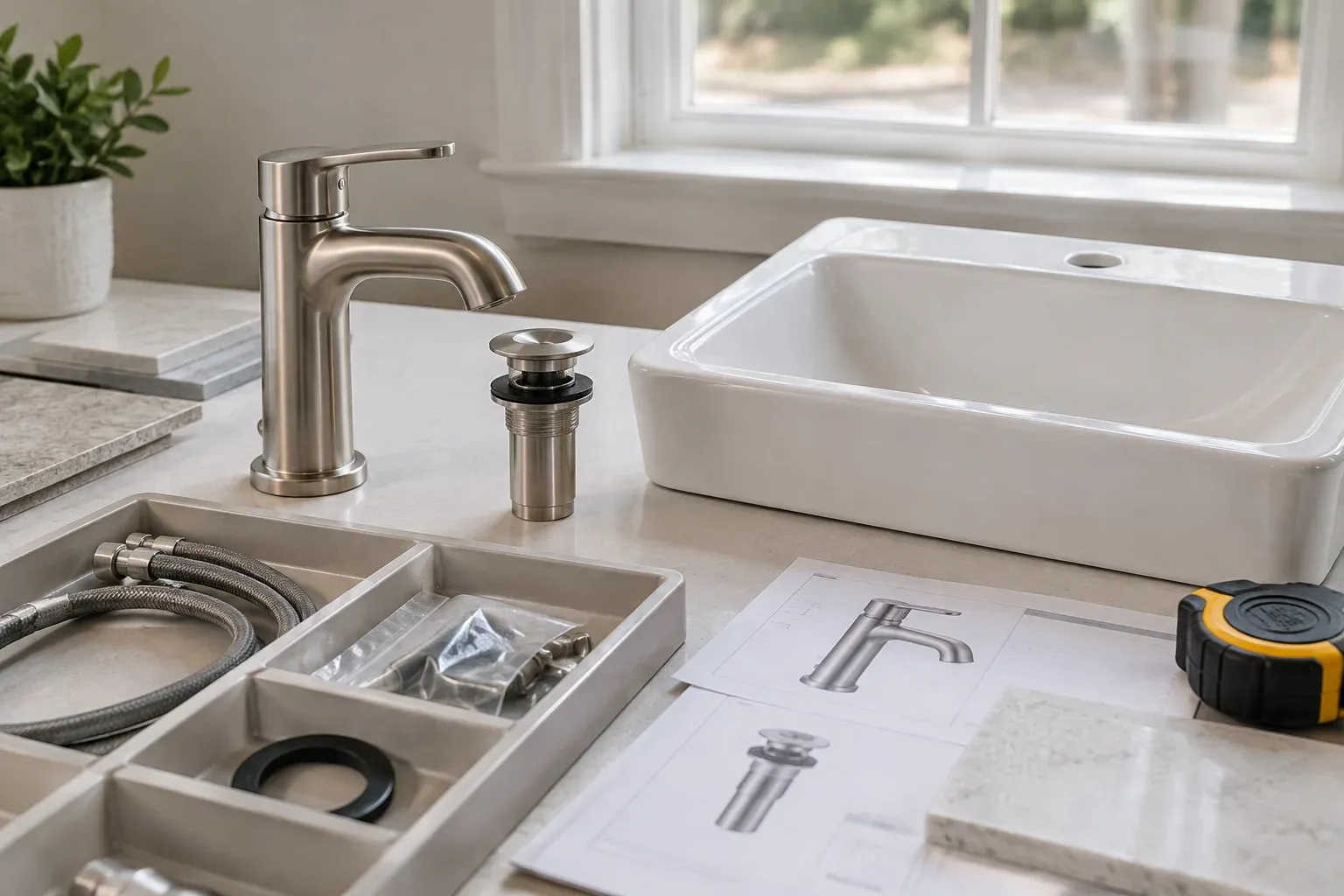
Assign responsibilities with a simple purchasing checklist
Owner-purchased should not mean owner-assumed. Agree on who selects, reviews, orders, receives, stores, and resolves problems for each item. One person may buy a fixture while someone else purchases its supporting components, but that division needs to be explicit. Otherwise, both parties may order the same accessory—or each may expect the other to supply it.
A shared purchasing record makes those assignments visible. Keep it simple enough to update: identify the item, responsible purchaser, review status, order status, expected arrival, and installation milestone. Good project planning and coordination also includes agreement about delivery handling and any work outside the original installation scope. Purchasing directly does not, by itself, establish who will unload a shipment or manage a return.
- Identify the exact model, finish, quantity, and intended location.
- Confirm product review and all required companion components.
- Name the purchaser and the person responsible for seller communication.
- Record the needed-on-site milestone and current delivery estimate.
- Arrange receiving, checking, storage, and later movement to the work area.
- Confirm completeness and condition before marking the item installation-ready.
Align orders with construction milestones
Ask when the product information is needed and when the physical item is needed. Those can be different milestones. A fixture installed near the end of construction may influence decisions much earlier, while cabinets or flooring may need to arrive before other finishing work can proceed. Organize orders around those dependencies rather than around a single hoped-for completion date.
Distinguish an order confirmation, an expected shipping date, and an expected arrival date. Check whether the supplier plans to send everything together or in separate shipments. Give the contractor updated information when availability changes, and allow room in the plan for checking deliveries and resolving problems. A carton arriving on the morning the installer is scheduled leaves little opportunity to discover and replace an incorrect item.
Arrange storage before choosing the delivery address
An early delivery is helpful only when there is a suitable place to keep it. Before choosing a delivery address, discuss whether the house is enclosed, whether secure storage is available, and whether the material needs particular conditions under its manufacturer’s guidance. An unfinished room or garage should not be assumed suitable for every finish simply because it has available floor space.
Plan the route as well as the storage spot. Large or heavy items may need an agreed receiving arrangement and qualified handling. Stored cartons should not obstruct access or force trades to move materials repeatedly. Keep related components together, preserve packaging, and make each item’s intended room easy to identify. If you store purchases elsewhere, include their later transport to the house in the plan.

Check deliveries before the installation appointment
Arrange for a designated person to check deliveries promptly rather than simply count boxes. Compare the shipment with the order: model, finish, quantity, visible condition, and included accessories. A complete carton count does not establish that the correct products arrived. Photograph damage or discrepancies, retain relevant packaging, and record anything that still needs confirmation before the item is released for installation.
Review the seller’s return and problem-reporting policies before purchasing, especially for special-order or clearance items. Keep receipts, order confirmations, shipping promises, and correspondence together. The FTC’s online shopping guidance recommends reviewing delivery and refund policies and retaining purchase records. Those records help the purchaser explain a shortage or incorrect shipment without reconstructing the order from memory when construction is waiting.
Resolve exceptions without creating another mismatch
If an item is missing, damaged, or incompatible, notify the contractor and the responsible purchaser as soon as the issue is known. Describe the specific problem and provide the order details and photographs where useful. Ask which work depends on the item and whether other tasks can proceed. The contractor needs reliable information to assess the effect on the construction sequence.
Keep the affected item separate from materials cleared for use. Do not assume a similar-looking replacement will solve the problem or ask an installer to improvise around an unsuitable product. Have the proposed replacement reviewed, confirm the seller’s next steps, and update the purchasing record with the revised arrival information. A substitution may also change related selections, so consider the complete assembly rather than the isolated missing piece.
Make readiness—not ordering—the final checkpoint
For custom home construction in Whispering Pines, owner-purchased finishes work best when selection and construction planning stay connected. Before placing an order, confirm the exact product, its companion parts, the purchasing responsibilities, and the delivery plan. Before installation, confirm that the shipment is complete, suitable, undamaged, and accessible. Bringing those questions to your planning conversation with Cornerstone Construction helps make your preferences clear without treating a purchase receipt as proof that everything is ready.
Frequently asked questions
Should I buy fixtures before meeting with my general contractor?
Gather ideas and product information first, but coordinate the exact selection before ordering. Your contractor and the relevant trade need to check whether the item suits the planned layout, supporting materials, and installation sequence.
Can owner-purchased finishes be delivered directly to the construction site?
Possibly, but arrange it in advance. Confirm that someone can receive and check the shipment, suitable storage is available, and the delivery service includes the handling you need. An active construction site is not automatically ready to accept every shipment.
What should I do if a fixture arrives with missing parts?
Keep the packaging, record what is missing, and contact the seller promptly. Notify your contractor so the affected work can be assessed. Do not assume the installer can supply a substitute; have any proposed replacement checked before proceeding.